
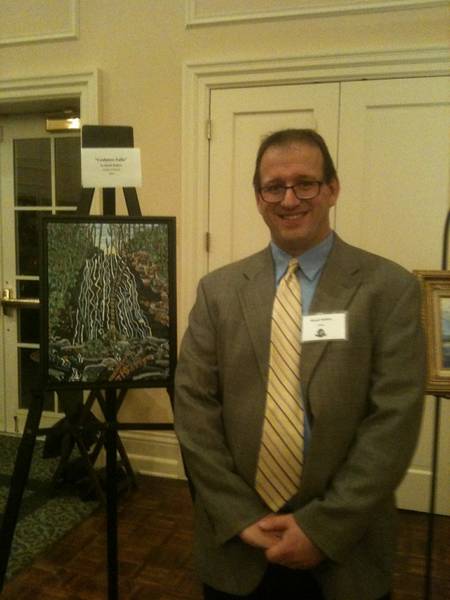
Wow what a night! A second place award for my Crabtree Falls painting, several sales and now a solo show at the club through the end of March.
Painting and abstracting the landscape of the Southeastern United States. www.micahmullen.com


One month ago, Micah Mullen walked away from a comfortable corporate marketing job in the midst of a still-sputtering economy to work full time as a painter.
It's a 70 percent pay cut, though the hours are better. He and his wife have reined in food expenses, and with Mullen home, the couple can save on day care for their elementary-age children.
Still, Mullen knows it won't be easy. But he's determined to try.
"I don't plan on turning back," Mullen said. "I want to make this work, and I think I can."
Mullen is jumping in at an odd time for the Raleigh art scene. With more galleries than ever, the city's commitment to public art and the opening of the new Contemporary Art Museum downtown, the area is in the midst of what Raleigh Art Commission Executive Director June Guralnick calls a cultural renaissance.
However, individual artists are grappling with an extended period of fewer patrons and lighter wallets as the area struggles to bounce back from the recession. Local artists say they have had to work harder and smarter than ever before to make ends meet.
Mullen's geometric North Carolina landscapes are striking enough to stop patrons in their tracks, said gallery owner Nicole Kennedy, who sells Mullen's work in Nicole's Art Studio and Gallery on Person Street downtown.
"People look at his stuff and they're mesmerized," Kennedy said. "The more you look at it, the more you like it."
At the same time, Mullen has picked a tricky time for his career change.
"Leaving your day job - that's not necessarily a good thing to do right now," Kennedy said.
Even in the best of times, there aren't many who have the combination of talent and boldness required to take on the life of a professional artist. Only about 23,600 people held jobs as fine artists like Mullen and Garrison in 2008, the most recent numbers available from the U.S. Bureau of Labor Statistics. About 60 percent of those were self-employed.
Most work on a freelance basis and may find it difficult to make a living solely by selling their artwork, according to the bureau report. Those with a steady salary earn a median annual income of about $42,000, which is Mullen's goal in the next five years.
Most local artists have been riding out the recession through a combination of newly acquired business savvy and a focus on honing their craft, Kennedy said.
"Most artists have had to take their career in their own hands," Kennedy said. "To expect galleries to make a living for you, unless you're a huge name, is not realistic."
Even established artists have had a hard time. Raleigh painter Richard Garrison quit his job as a public school art teacher to paint full time 16 years ago. He and his wife, an English teacher, were able to live comfortably off their joint incomes for more than a decade in a large four-bedroom house in Cary.
Then the recession hit. During the past few years, Garrison has been selling half the number of paintings he used to. He and his wife have had to dip into their savings, and recently downgraded to a one-bedroom condo in downtown Raleigh.
Last year, Garrison decided on a new strategy. His new focus on portrait painting won him two commissions last year that "probably saved me, financially," Garrison said.
Even those who kept their day jobs say times have been tight. Local artist Joe DiGiulio works full time in commercial and educational sales with Jerry's Artarama, as well as teaching workshops and creating instructional art DVDs. He and his wife call their backyard studio their retirement plan, a place to continue teaching art classes as the income supplement they will need to retire.
"I was surprised that (Micah) was going to go full time," DiGiulio said. "Three years ago, it was a completely different story."
Mullen has done his research. He knows the career change could mean a difficult adjustment period. He's been painting for years, and sold $20,000 worth of his work last year while working full time. With so much more time free to invest in it, he is confident he can double that number within five years.
His wife Eileen, a personal injury lawyer, supports his decision completely - because of his obvious talent, and the positive change she has seen in her husband since he found work he loves: He's calmer, more social and has more time to spend with their two sons.
"It is amazing to see the change in a person when they figure out what they want to be doing and what they're good at," Eileen Mullen said. "It really does make a difference to have fulfillment in your work life."
Mullen is treating his new career the same way he did his full-time corporate job. He starts at 8 a.m. every morning in his upstairs studio in North Raleigh, creating new paintings or on business calls, working to get his canvaases in more galleries across the state. On a whiteboard on one wall, he meticulously tracks how he spends every hour of the work day. To supplement income from paintings, he has instructional DVDs, which he sells from his professional website. He also has his own show in the N.C. Museum of Natural Sciences' Nature Art Gallery through May 1.
Kennedy notes that North Carolina landscapes are selling better in the down economy as patrons seek the comfort of the familiar. That Mullen's work is a fresh, striking take on those scenes may be exactly the thing that will allow his bold career move to pay off as the economy picks back up, DiGiulio and Kennedy agree.
"I've seen enough lighthouses and ... barns and rolls of hay in the field from painters all over this area," DiGiulio said. "Micah's work is totally unique from anything you've seen before, so he can really carve out a niche for himself."
An artist's life has never been easy, but for those like Mullen, it's worth it to try, Garrison said.
"Why do anything other than what you love?" Garrison said. "If you love it enough, and you follow your heart, I think things will fall into line and you can make a living of it."
The tornadoes that swept through Eastern North Carolina last weekend did a number on my mailbox. I spent Easter weekend building a new mailbox and creating a small mosaic garden at the base of the mailbox. Chips of broken plates and other odd ceramic pieces were embedded into two concrete pads. These pads were then surrounded by mulch and some small plants. The tiles need to be polished and the excess concrete and mud needs to be wiped off, but otherwise this project is complete.

Pearson's Falls was the last waterfall we visited in our annual fall waterfall trip. This waterfall is located in the southwest part of North Carolina between Saluda and Tryon. It was a bright crisp autumn day - that allowed for some experimentation when painting the sky.
Working in the art material industry for many years I have seen hundreds of products. Occasionally a product comes around that really stands out as a quality item. The Fredrix Dixie Pro Canvas is one of those unique items of exceptional quality. This is a 12 oz. cotton canvas stretched onto solid, quality wood stretcher bars. What I like about this product is I know I do not have to worry about the canvas failing during the painting process or years in the future. The tough heavy canvas allows for a variety of techniques with a brush or knife without any concerns of the canvas bubbling or wrinkling, and the solid stretcher bars assure me that this canvas will not warp even decades from now.
The reception at the Nature Art Gallery at the Science Museum last night was amazing! I chatted with dozens of friends, met some great people and had a great time with my family. A special thanks to Karen Bethune who is curator of the gallery, she is one of the nicest and most efficient people I have come across. My paintings looked amazing in the gallery - congratulations to her and the great staff at the Museum. I am looking forward to working on future projects with the North Carolina Museum of Natural Sciences. 
The Gallery exhibits original, nature-inspired, two and three dimensional artwork in all mediums by many of the finest artists and artisans exhibiting in the Southeast.
Bring the whole family - As part of First Fridayboth the Nature Art Gallery and the NC Museum of Natural Sciences are open late.
Painting shown is: Cotton Field Off Highway 64 #3 - 20x20" Acrylic on Canvas

This past weekend I probably spent 24 solid hours cleaning and organizing my studio. All my paint tubes are arranged by chromatic hue, all the brushes are sorted by size and style, the floors are vacuumed and swept - all and all this is the cleanest and most organized my studio has been in years! I'm anxious to see what effect this will have on me as an artist. Already I am finding myself mixing my red tubes with blue tubes and my filberts with my brights. I ponder whether I should spend a few hours a week or a half hour or so each night keeping things clean. I guess I probably should, if nothing else organization saves money - this past weekend's overhaul revealed several unused paint tubes and even large canvases I did not know I had!
Today is the first day of my life where I sat down at the easel knowing this is now a full time job.
For nearly fifteen years I was gainfully employed at Jerry’s Artarama as the Marketing Director. Earlier this year I decided to resign from Jerry’s with last Friday being my last day of employment. The past several months have been filled with emotions (both and good and bad), but I know it is now time to put these aside and look towards the future and begin the life of a full time artist.
The image shown is the cover of the 2011 Jerry’s Catalog. During my career at Jerry’s I have been involved with hundred of catalogs covers. It is ironic that I was involved very little with this cover in the sense that in the same year Jerry’s chose to embody the slogan “Empowering Artists” is the same year I chose to part ways with the company and try to make a go of it as a full time artist.
I have alot of thoughts about Jerry’s both positive and negative - however I know one thing is for certain that were it not for the experience gained through Jerry’s I would be nowhere remotely close to pursuing a career as a full time artist.
I will be writing much more frequently on my blog on my daily experiences as an artist, a father, a husband and a human being. Please check back.


We visited this area last Fall. After hiking several miles up we reached the top of Hanging Rock which is where I shot the picture that inspired this painting. When I began photographing the area I knew almost immediately the types of paintings I would do. The rock is so massive and the view is so spectacular it created two distinct elements that had to be separated. I decided that I would paint the rock directly on the glass and offset it about a half inch from the panel to give me some depth. I began first by painting the sky on the panel - it was not my intention to give the sky so much attention, but I found that some of the colors I was using were not giving enough vibrant punch. I knew these would be behind glass, so I needed to make the sky jump out. The mountains in the back ground are a bit more subtle but help in making the sky and the rock really come alive.
Painting on glass is always a challenge as it has no absorption. Even traditional primers like gesso do not always adhere well. Several coats of priming were used and even then the surface is still pretty tough. I painted the rock, by first using traditional heavy body acrylics in a series of color patterns. After about 8 hours the basis of the rock had formed, but the colors were not vibrant and streaked alot. I then used acryl Gouache to go back over these colors. Everything on the rock is opaque, so I did not concern myself with losing transparency by using the gouache. After doing this I again used the acryl gouache and made the patterns and symbols on the rock that are found in many of my works.
When I finally framed the piece and offset the glass from the panel got really excited from the results. The additional work and challenges of working on glass definitely paid off!.

I came across this Tobacco field not far from my home on Rolesville Road in Northeast Raleigh. The picture was taken in late October so there were some interesting fall colors in the composition. I used some of my favorite Matisse acrylic colors to create this painting. Australian Sienna is somewhat of mix of Raw Sienna and Cadmium Orange – you see a lot of this in the field and in the center of the big tree. Some of the greens used are Australian Olive Green and Australian Sap Green – I generally avoid specialty colors like these, but the Australian series of Matisse acrylics is a real good range.
Matisse Flow paints are a thinner consistency and match the color range of the heavy body structure acrylics. I use these for glazing and for accentuating certain areas. The big shiny leaves on the tree and certain areas of the field are a combination of Flow acrylics and glazing medium. I usually apply this with applicator bottles, similar to how one might decorate a cake. This gives a neat effect that works well with things like flowing water or leaves blowing in the wind.
Corner of Rolesville and Puryear Road - 12x12" Acrylic on Canvas


Just a short distance from the Blue Ridge Parkway in western North Carolina is WIldcat Falls. We came upon this waterfall on a cold November morning but were not disappointed as this is really a picturesque setting. When painting this I tried to show alot of movement not only in the waterfalls but in the surrounding trees as well. The pool at the base of the waterfall was probably about 12" deep in the spot where I stood to take the picture. This shallow water gave hints of the surface with alot of browns and siennas being evident. As the water got deeper at the splash area of the waterfall more blues, greens and even purples became evident in the composition.
This is painted on a 12"x12" canvas - Despite the small area of the surface I was able to get alot of detail into the rocks and trees. People often say my paintings are aboriginal or Aztec in appearance. Perhaps WIldcat Falls defines a bit of both of these styles.
Wildcat Falls - 12x12" Acrylic on Canvas


And the Grinch, with his Grinch-feet ice cold in the snow, stood puzzling and puzzling, how could it be so? It came without ribbons. It came without tags. It came without packages, boxes or bags. And he puzzled and puzzled 'till his puzzler was sore. Then the Grinch thought of something he hadn't before. What if Christmas, he thought, doesn't come from a store. What if Christmas, perhaps, means a little bit more.
~Dr Seuss
Wishing You a Merry Christmas!
Micah
North Carolina Cotton Field - 30x40" Acrylic on Canvas
| Subscribe to Micah's Newsletter |